

I’ve Cried More Over Jobs Than I Ever Did Over Love

Heartbreak amplifies everything—makes music unbearable, nights interminable, your own bedroom feel like a stranger's apartment. We accept this as the cost of caring about someone. But getting fired? Getting slowly iced out of a company you once memorized the values statement for? That's a different species of heartbreak entirely. Infinitely more humiliating.
I used to think nothing could touch romantic rejection. Then I started job hunting seriously (Like an actual adult should).
Here's the thing about breakups: at least they have narrative coherence. Two people, one decision, some ugly crying in between. There's a beginning, middle, and end you can explain to your therapist. When a job ends—especially suddenly—it doesn't feel like a story. It feels like a door slamming in your face while your hand's still reaching for the handle.
And sometimes, it happens on a Tuesday.
I got dismissed on the most aggressively normal workday imaginable. My boss called before lunch and said things weren't "moving in the direction she expected." Classic manager-speak. I assumed it was feedback—you know, that thing reasonable leaders do where they course-correct before detonating your entire sense of professional self-worth. So I kept working. Finished my afternoon tasks. Answered Slack messages with little thumbs-up emojis. Submitted what was pending. Stayed polite, professional, useful.
Then, ten minutes before five, she called again.
The conversation lasted maybe ninety seconds. "Thank you, I'll take it from here." Neutral expression, like she was declining a second glass of wine. And then that small, antiseptic sound of the video call ending.
That digital click haunted me longer than any breakup text ever did.
No one prepares you for corporate grief.
I stared at my screen for almost five minutes, watching "The call has ended" as if the words might rearrange themselves into something less final. Because I was working from home—thank god for small mercies—I walked straight to my bed and cried. My parents thought I'd broken up with my boyfriend.
It felt worse than that.
The Mathematics of Rejection
Breakups usually announce themselves. Arguments. Distance. That subtle atmospheric shift where you know something's dying even if no one's said it yet. Even ghosting, as psychologically violent as it is, often follows tension. You sense it coming.
Job loss is different. It's clinical. You go from "valued team member" to locked out of Slack in under five minutes. Your laptop becomes a brick. Your email bounces. Your Zoom background, which you picked so carefully to look professional-but-approachable, becomes irrelevant.
Tell me that isn't more brutal.
With men, I've learned something clarifying: if it ends, it ends. You cry, you block, you archive the chat, you romanticize it for approximately one week while listening to Phoebe Bridgers, and then you slowly metabolize the loss. People say the fastest way to get over someone is to meet someone else. Cliché, but occasionally true. Human connection can replace human connection, at least partially.
Rebound culture doesn't exist in employment.
You can't swipe right on a new job and have five interviews within an hour. The hiring process is a months-long psychological endurance test where you tailor your CV seventeen times, rewrite your cover letter until it sounds both confident and humble (an impossible balance), rehearse answers to behavioral questions in your head like you're preparing for a hostage negotiation, and then—after three rounds of interviews—you refresh your inbox like it's about to confess its love for you.
And statistically, it often takes months.
You can download Hinge and have five matches before you've finished your iced coffee. A hiring process can stretch over three months and still end in silence. No rejection email. No explanation. No "it's not you, it's us" courtesy. Just nothing. And the silence is what makes it unbearable.
When a man ghosts me, I can label it. Cowardly. Emotionally stunted. Not aligned with my attachment style. I can assign responsibility and move on with certain clarity. When a company ghosts you after three interviews and a presentation you stayed up until 2 AM perfecting, it feels existential. Did I say something wrong? Was I too confident? Not confident enough? Was I almost chosen? Did they laugh at my portfolio after hanging up?
No one tells you. You just sit with your assumptions, which is its own special hell.
The Romance of Job Descriptions
We romanticize job listings the way we romanticize potential partners.
The fantasy of the perfect boyfriend is obvious: emotionally intelligent, cooks dinner without asking for praise, financially stable, calm under pressure, attentive, someone who feels like a safe place. We all know the checklist, even if we pretend we don't.
The fantasy of the perfect job is just as seductive:

Hybrid schedule. (But not really tracked, you know? Like, trust-based?)
Early Fridays.Unlimited PTO that people actually use without passive-aggressive calendar comments.
Lunch stipend.
Smart coworkers who respect your Slack boundaries.
Creative projects.
A boss who mentors instead of micromanages.
A culture that doesn't make you feel like you're slowly disappearing.
We fall in love with job descriptions the same way we fall in love with potential. And potential is dangerous, because potential is a story you tell yourself while ignoring the present-tense reality.
Sometimes you finally get the role—the title, the salary, the carefully crafted LinkedIn announcement—and two months later you're crying in your bathroom because the culture feels toxic, your manager communicates exclusively in passive-aggressive Slack threads, and you've started shrinking yourself to survive.
Tell me that doesn't feel like dating the "perfect guy" who slowly reveals himself to be emotionally unavailable with control issues.
The Stakes Are Different
Love bruises your ego. Work bruises your survival.
Money is quiet pressure. It hums in the background of every decision—rent, bills, savings, that existential retirement account you're supposed to be contributing to. When a relationship ends, your bank account doesn't immediately tremble. When a job ends, it does. That's why the tears feel different. They're not just about rejection. They're about fear.
There's something deeply personal about professional rejection that we don't acknowledge enough. Companies insist they hire for skills, but interviews are never only about skills. They ask about your personality, your ambitions, your values, your story. They ask who you are. And in that process—even if it's just a 20-minute Zoom call where you're performing the most hireable version of yourself—you start to bond. You see their faces. You read their reactions. You try to connect. It feels surprisingly human.
So when they don't choose you, it doesn't feel like they rejected your Excel abilities. It feels like they rejected you—your presence, your way of thinking, your energy—all packaged into a polite, bloodless corporate sentence:
"Not the right fit."
Fit for what? For whom? For the version of myself I tried so carefully to present?
There's a shame attached to professional rejection that we don't discuss in polite company. In dating, incompatibility can feel mutual, or at least narratively defensible. At work, it often feels one-sided and documented. Somewhere, in some shared drive, there's probably a spreadsheet with your name and a score.
Dignity, Calculated
Ending a situationship after months of "what are we?" conversations hurts, but there's dignity in choosing yourself. You decide you deserve more, and you leave. Clean break. Blocked number. New chapter.
Leaving a job for dignity is rarely that simple.
You calculate. You plan. You update your resume in secret, probably on your personal laptop after midnight. You smile in meetings while emotionally packing your desk. You don't just walk away; you strategize your exit like it's a financial maneuver, because it is.
And if you get laid off unexpectedly—even when it's demonstrably not your fault, even when it's budget cuts or restructuring or some vague "market conditions" excuse—there's a strange humiliation attached to it.
No one whispers, "I'm embarrassed I got dumped." But people lower their voices when they say, "I got let go."
We don't consciously attach morality to romantic rejection the way we do to professional rejection. But we internalize it anyway. Like somehow, if you were just better—more productive, more indispensable, more aligned—you would've been kept.
Jobs can be toxic. Managers can be insecure. Companies overhire, underplan, and cut budgets without warning. Sometimes you become a line item on a spreadsheet. That doesn't mean you were unworthy.
But it still feels personal.
I've cried over performance reviews more than over men who couldn't commit. I've replayed thirty-minute meetings in my head for weeks, dissecting every word choice, wondering what I could have said differently.
You Can't Opt Out
With dating, you can delete the apps and take a break. Announce a "hot girl summer" where you focus on yourself. Go to therapy. Read self-help books. Be single for a while.
With work, you can't opt out of the system. You still need income. You still need health insurance. You still need some kind of structure to prevent existential freefall.
And here's the uncomfortable truth I've been circling: I have tolerated more emotional inconsistency from workplaces than from men.
I would never accept a partner who constantly belittles me, changes expectations without warning, or ignores my boundaries. In professional settings, we call that "high-performance culture" or "being adaptable." We call it "wearing many hats" or "thriving in ambiguity."
We romanticize hustle the way we romanticize emotionally unavailable people. Both will drain you if you let them.
And Yet
I still believe in both.
I still believe there's a job that feels aligned. A team that feels supportive. A structure that doesn't require amputating parts of yourself to fit. In the same way, I still believe in healthy love—the kind that doesn't require performing or shrinking or constantly second-guessing.
Maybe that's the real parallel. It's not that work hurts more than love. It's that we invest in both with hope. And hope, when disappointed, leaves a particular kind of bruise.
When I say I've cried more over work than love, it's not because love didn't matter. It's because work touched parts of my identity I didn't realize were fragile. It questioned my competence, my direction, my timeline. Love questioned my desirability. Both sting. But only one makes you open LinkedIn at midnight and reconsider your entire existence while comparing yourself to people from your freshman orientation.
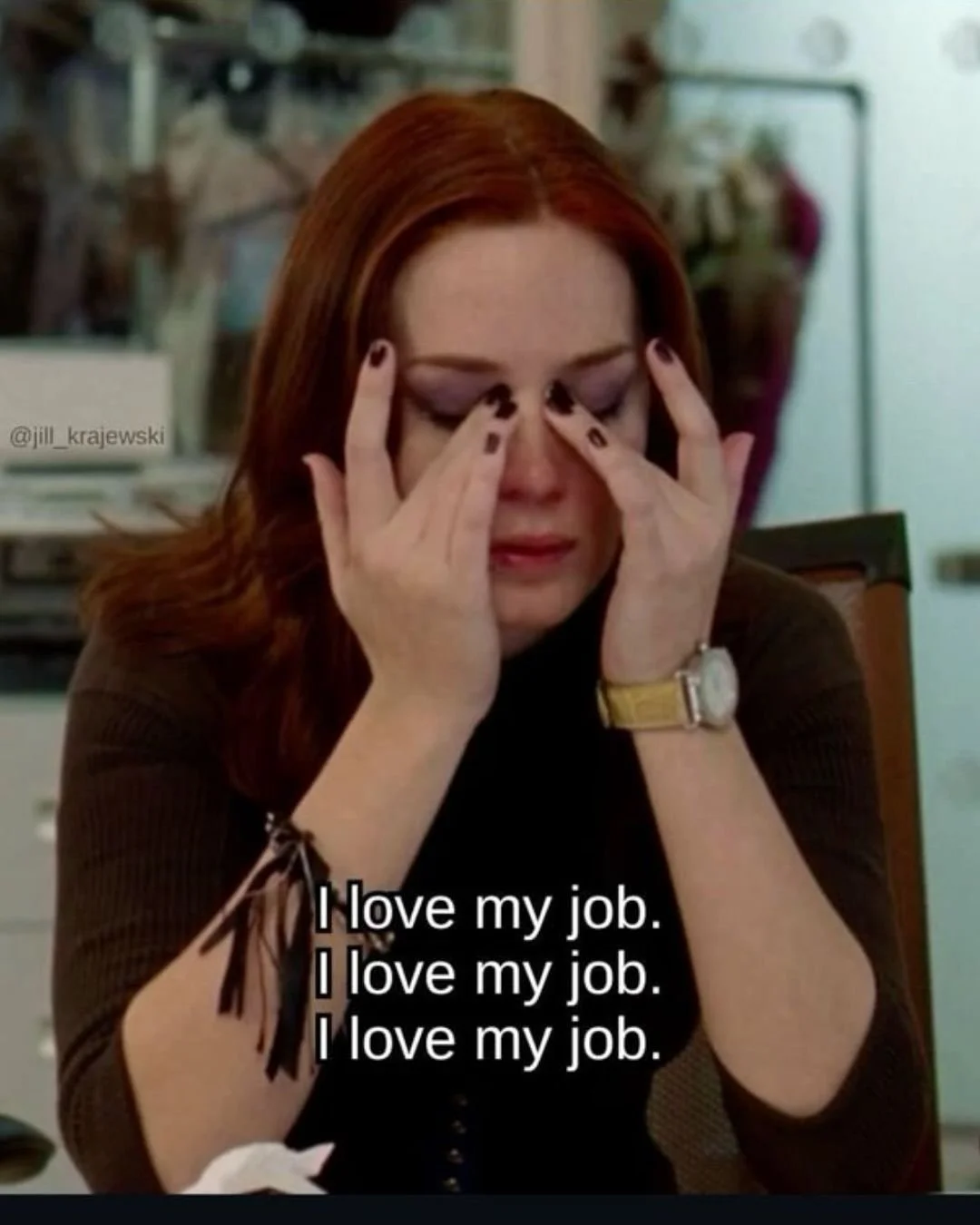
Crying over work doesn't make you weak. It means you cared. It means you wanted growth, stability, respect. It means you believed in something.
Even if I've cried more over work than love—especially this past year—I've also kept going.
That's the part we don't dramatize enough.
Still Figuring It Out
I haven't found my place in the professional world yet. I'm not writing this from a corner office or behind a perfectly optimized LinkedIn headline. I'm still figuring it out. And I don't want to romanticize the process, pretending there won't be another rejection email, another moment of doubt, another night where I question whether I'm doing everything wrong.
There probably will be.
But I know—with a strange, stubborn kind of certainty—that what I've lived through in my twenties isn't wasted time. The bad bosses, the sudden endings, the interviews that went nowhere, the jobs that looked perfect and felt wrong. They're not detours. They're the road.
Maybe this is the work I have to do before I arrive where I'm meant to be. And yes, I said work on purpose.
Because even if I haven't found the place where I fully belong yet, I'm still building the version of myself that will recognize it when it appears. I'm still learning what I tolerate, what I refuse, what I need. That has to count for something.
The quiet joke in all of this is that right now, my career breaks my heart more often than love does.
And strangely, I'm okay with that.
It used to be the other way around—my entire emotional infrastructure organized around whether some guy texted back. Now, caring more about my work than about romantic chaos feels less dramatic and somehow more peaceful. For my mother, it probably sounds like tragedy. For my future self, I think it's a form of calm.
Because if I'm going to cry, struggle, grow, and rebuild anyway, I'd rather do it chasing something that builds my independence. Something that shapes my mind. Something that will still be mine even if someone leaves.
I don't know exactly where I'll land.
I just know I'm not done.
And maybe that's enough for now.
